Welcome to the kampong kitchen! In this post, we’ll explore the kampong kitchen, birthplace of Singapore cuisine, and what kampong cooks used to create tasty meals for their families!
To learn more about Singapore cuisine history, please be sure to check out our previous post about Singapore food history and its origins.
What’s in the kampong kitchen?
A typical kampong kitchen. Image courtesy of National Archives of Singapore
The kampong kitchen is nothing like the modern kitchen we are used to. It had no refrigerators, modern stoves, appliances or running water.
It was a rustic kitchen outfitted with extremely basic items like a cleaver, chopping block, a few pots and pans (especially a deep wok known as a kuali), a kettle for boiling water, wood stove, fire tongs and a palm leaf fan for stoking the fire.
Note the mesh-lined cupboard in this kampong kitchen. Image courtesy of National Archives of Singapore
Many kampong kitchens also had a wooden cupboard lined with wire mesh. This cupboard was used for storing dishes and food, and the wire mesh prevented insects and chichaks (geckos) from getting to the food while also allowing for ventilation.
This is an extremely important feature because in Singapore kampongs, windows are often left open for ventilation and there are no window screens to keep out bugs. This means that every kampong dwelling houses its fair share of household pests and yes, even rats.
Cooking with fire
A wood stove used in a Choa Chu Kang kampong. Image courtesy of National Archives of Singapore.
For most of Singapore’s food history, kampong kitchens had no modern gas or electric stoves.
Food was cooked on wood stoves with firewood collected from the wild or purchased from sawmills. Charcoal and kerosene were sometimes used but it was less commonly used because they cost a lot more than wood.
If you have ever manned a BBQ grill, then you know that cooking with fire is unpredictable and tricky, and can make cooking even more challenging. Wood fires also created a lot of smoke and indoor kampong kitchens were often hazy from poor ventilation.
Cooking with what you have
A market in early Singapore. Image courtesy of National Archives Singapore.
The kampong cook did not have the luxury of a well-stocked fridge or pantry.
Shopping was done once a day and people only bought what they could use up that day because there was no way to keep food fresh.
The exception was for ingredients with a longer shelf life like rice, dried/salted seafood and preserved vegetables.
These shelf-stable food items allowed the kampong cook to put food on the table on days when fresh vegetables and meat were not available.
Who were the kampong cooks?
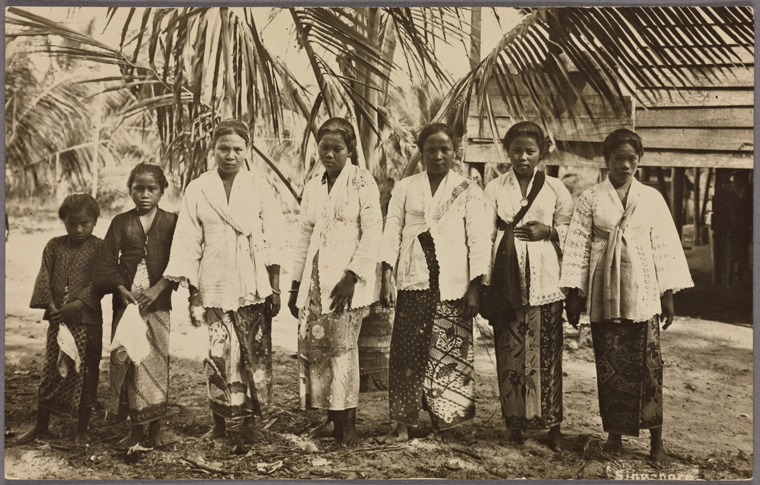
Malay women and children. Art and Picture Collection, The New York Public Library. “Singapore.” The New York Public Library Digital Collections. http://digitalcollections.nypl.org/items/c2634d03-24b6-f238-e040-e00a18061845
A kampong cook of early Singapore was usually a woman in charge of cooking for her large extended family. Not only did she have to cook three meals a day, she was also responsible for the care of young children, elderly parents, and the general running of the household.
There was also livestock and vegetable gardens to tend to, and laundry and cleaning, all of which she did even when she was pregnant!
It was a hard life and yet, she managed to churn out meal after meal for her family without fail. For without the kampong cook, the family would simply starve.
And it is through the labor of these remarkable kampong cooks that Singapore cuisine was born and nurtured into the world-renowned cuisine we know today.
Top image: Art and Picture Collection, The New York Public Library. “Malay girl, Singapore.” The New York Public Library Digital Collections. http://digitalcollections.nypl.org/items/c2634d03-247b-f238-e040-e00a18061845
Welcome to my kampong! This is a place where you’ll learn all about Singapore’s rich food history and it’s delectable cuisine!
To begin, we’ll have to travel back in time, when Singapore was an island of rustic villages known as kampongs.
Singapore kampongs
Back in the 19th century when Singapore island was a swampy backwater, its early settlers lived in settlements that ranged from small shantytowns with dirt roads to self-containing hamlets with small stores, schools and mosques.
And it was in these kampongs where Singapore cuisine history first began.
How kampong life influenced Singapore cuisine history
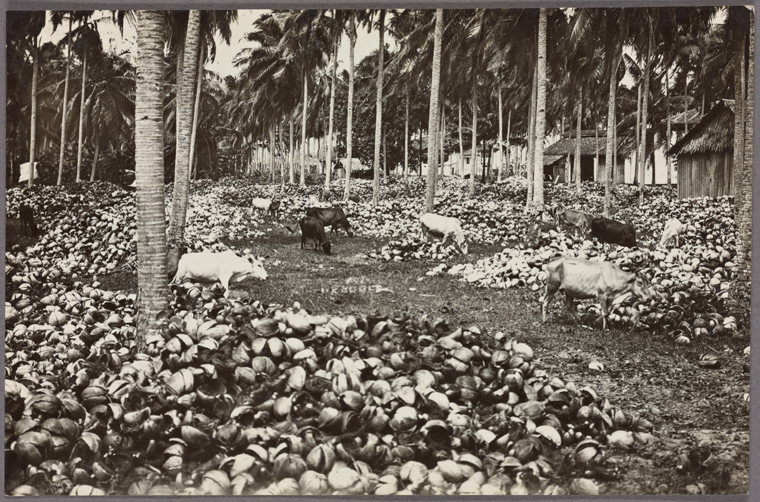
Kampongs had open spaces for growing food and raising livestock.
Art and Picture Collection, The New York Public Library. “Cattle grazing amid piles of coconut shells, Singapore. The New York Public Library Digital Collections. http://digitalcollections.nypl.org/items/c2634d03-24a9-f238-e040-e00a18061845
Unlike life in modern Singapore, kampong life was simple and idyllic. The pace of life was slower and less stressful, and it was impossible to walk around without nodding at a familiar face.
Large extended families lived together under one roof and everyone, including children, helped with household duties like laundry and feeding the chickens.
Kampong food
With more space to maneuver about in the kampong, most kampong folks also raised chickens and pigs, and tended to vegetable beds and fruit trees.
Here’s a sample of what kampong folks ate:
Freshly caught fish and seafood, like sotong (squid), cockles and prawns
Homegrown vegetables and fruits grown without pesticides
Rice, tea and biscuits bought from shops
Treats like ice balls and cold drinks were bought from street vendors
Homemade kueh (Malay cakes) were shared with family and neighbours
Malay vs. Chinese kampongs
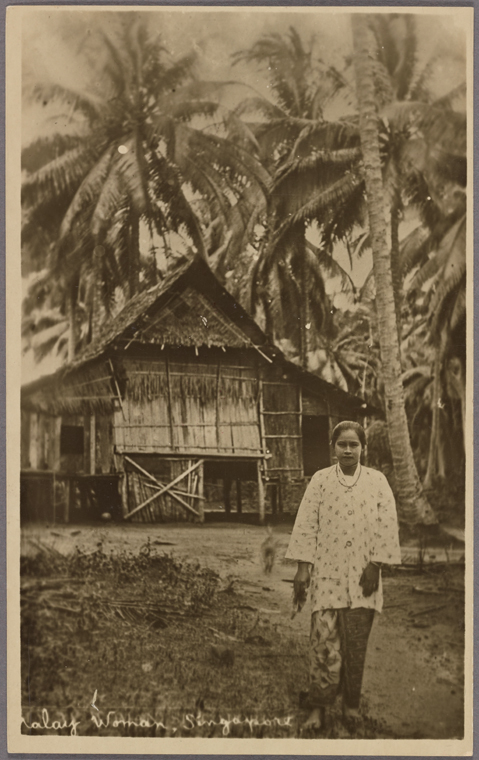
Malay woman in a Malay kampong. Note the stilts and gabled roof. Art and Picture Collection, The New York Public Library. “Malay woman, Singapore.” The New York Public Library Digital Collections. http://digitalcollections.nypl.org/items/c2634d03-249f-f238-e040-e00a18061845
Depending on the racial makeup of the kampong, the settlement could have different amenities and architecture.
Generally speaking, in a Chinese kampong, there were:
Chinese stores like medicine shops and provision shops selling herbs and sundries
Single-storey dwellings with zinc roofs
Houses with fences
Pigs raised by the home owners
In a Malay kampong, there were:
Mosques
Houses built on stilts to keep out wild animals like snakes and tigers, and to provide ventilation and prevent flooding
Houses with stairs to get to different floors
Houses that are were fenced off
Not always idyllic
Life in the kampong might have been slower-paced but it wasn’t without its difficulties. Flooding was a common occurrence for many rural kampongs.
Sources of water for kampong folks:
wells dug by homeowners
piped water to public standpipes (available in the 1950s after the government constructed a water supply system to provide running water to rural areas)
piped water to individual homes (this was available around 1960s)
Queuing for water
In case you were wondering what a standpipe was, it’s basically a faucet located in a public area like a town square that’s open to the public. It provided running water to residents living in the area.
Public standpipes were the first form of running water available in the kampong and villagers had to queue up to fill their buckets. It was a laborious process to haul water home, so many villagers simply bathed, and washed their clothes and dishes by the standpipes.
Hot sticky kampong nights
To get a good night’s sleep in the kampong, mosquito netting is a must. https://commons.wikimedia.org/wiki/File:Mosquito,net,TamilNadu403.JPG
If you cannot imagine living without air conditioning in tropical Singapore, just imagine how uncomfortable it must have been for the villagers on a hot sticky night in the kampong.
Most people in the kampong slept under mosquito netting for protection from the pesky bugs, and with no electricity to power fans, they simply laid as still as possible to stay cool. According to my mother who grew up in a kampong, restless nights were common, but somehow, they still managed to fall asleep.
If you are lucky enough to talk to a former kampong dweller, chances are you’ll hear about something called the “kampong spirit”.
Broadly speaking, the kampong spirit is about cooperation and sharing with people in your kampong. It is similar to the Hawaiian aloha spirit.
Kampong folks were known for their kindness towards one another, as well as towards outsiders.
One famous example of kampong spirit took place during WWII, when Singapore was occupied by the Japanese forces. British and Australian residents, as well as other foreigners living in Singapore were rounded up by the Japanese forces and were taken to POW camps.
During the long hot march to the POW camp, the marchers passed through a few rural kampongs and eye-witnesses recalled that several brave kampong folks rushed out of their homes to hand the POWs water and coconut water.
Such selfless acts may be surprising to us but to a kampong dweller, it was just part and parcel of kampong life. It was simply the way things were done in the kampong.
Jackfruit tree
Bartering was a way of life. A couple of eggs for one’s neighbour yielded a gift of juicy mangoes next week; fixing a broken bicycle for a neighbour meant an extra hand was ready to help when it’s time to repair the leaking roof.
On and on, these little acts of kindness reinforced what it meant to live in a kampong, and fostered a cosy sense of belonging in every kampong resident.
Even luxuries were shared freely – it was common for neighbours to listen to the radio or watch TV together, as radio and television sets (black and white only) were affordable only to a lucky few.
If you grew up in a kampong, then you may recall sitting in a neighbour’s living room or coffee shop listening to a radio program broadcast by Reddifusion (Singapore’s first commercial radio station).
The Kampong Kitchen – birthplace of Singapore cuisine
So there you have it, a tour of the rustic kampongs of Singapore where the now world-famous Singapore cuisine was born!
Top image credit: A Malay kampong in Singapore. Art and Picture Collection, The New York Public Library. “Malay – village Pulo Brani Singapore.” The New York Public Library Digital Collections. http://digitalcollections.nypl.org/items/c2634d03-24af-f238-e040-e00a18061845