Welcome to the kampong kitchen! In this post, we’ll explore the kampong kitchen, birthplace of Singapore cuisine, and what kampong cooks used to create tasty meals for their families!
To learn more about Singapore cuisine history, please be sure to check out our previous post about Singapore food history and its origins.
What’s in the kampong kitchen?
A typical kampong kitchen. Image courtesy of National Archives of Singapore
The kampong kitchen is nothing like the modern kitchen we are used to. It had no refrigerators, modern stoves, appliances or running water.
It was a rustic kitchen outfitted with extremely basic items like a cleaver, chopping block, a few pots and pans (especially a deep wok known as a kuali), a kettle for boiling water, wood stove, fire tongs and a palm leaf fan for stoking the fire.
Note the mesh-lined cupboard in this kampong kitchen. Image courtesy of National Archives of Singapore
Many kampong kitchens also had a wooden cupboard lined with wire mesh. This cupboard was used for storing dishes and food, and the wire mesh prevented insects and chichaks (geckos) from getting to the food while also allowing for ventilation.
This is an extremely important feature because in Singapore kampongs, windows are often left open for ventilation and there are no window screens to keep out bugs. This means that every kampong dwelling houses its fair share of household pests and yes, even rats.
Cooking with fire
A wood stove used in a Choa Chu Kang kampong. Image courtesy of National Archives of Singapore.
For most of Singapore’s food history, kampong kitchens had no modern gas or electric stoves.
Food was cooked on wood stoves with firewood collected from the wild or purchased from sawmills. Charcoal and kerosene were sometimes used but it was less commonly used because they cost a lot more than wood.
If you have ever manned a BBQ grill, then you know that cooking with fire is unpredictable and tricky, and can make cooking even more challenging. Wood fires also created a lot of smoke and indoor kampong kitchens were often hazy from poor ventilation.
Cooking with what you have
A market in early Singapore. Image courtesy of National Archives Singapore.
The kampong cook did not have the luxury of a well-stocked fridge or pantry.
Shopping was done once a day and people only bought what they could use up that day because there was no way to keep food fresh.
The exception was for ingredients with a longer shelf life like rice, dried/salted seafood and preserved vegetables.
These shelf-stable food items allowed the kampong cook to put food on the table on days when fresh vegetables and meat were not available.
Who were the kampong cooks?
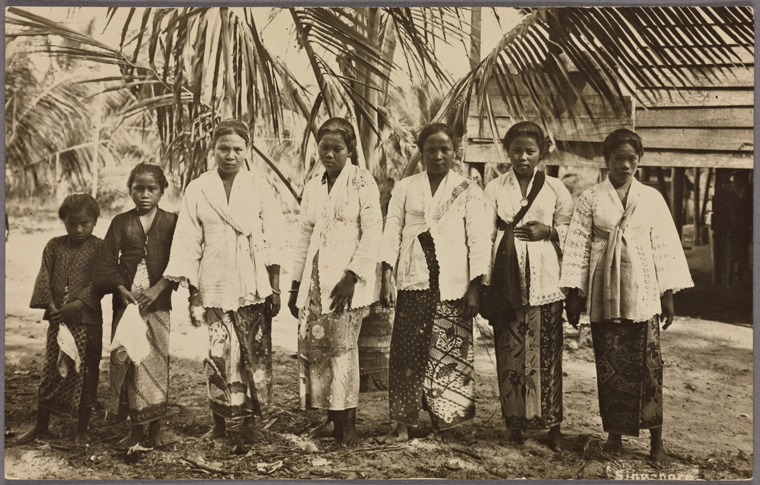
Malay women and children. Art and Picture Collection, The New York Public Library. “Singapore.” The New York Public Library Digital Collections. http://digitalcollections.nypl.org/items/c2634d03-24b6-f238-e040-e00a18061845
A kampong cook of early Singapore was usually a woman in charge of cooking for her large extended family. Not only did she have to cook three meals a day, she was also responsible for the care of young children, elderly parents, and the general running of the household.
There was also livestock and vegetable gardens to tend to, and laundry and cleaning, all of which she did even when she was pregnant!
It was a hard life and yet, she managed to churn out meal after meal for her family without fail. For without the kampong cook, the family would simply starve.
And it is through the labor of these remarkable kampong cooks that Singapore cuisine was born and nurtured into the world-renowned cuisine we know today.
Top image: Art and Picture Collection, The New York Public Library. “Malay girl, Singapore.” The New York Public Library Digital Collections. http://digitalcollections.nypl.org/items/c2634d03-247b-f238-e040-e00a18061845
Welcome to my kampong! This is a place where you’ll learn all about Singapore’s rich food history and it’s delectable cuisine!
To begin, we’ll have to travel back in time, when Singapore was an island of rustic villages known as kampongs.
Singapore kampongs
Back in the 19th century when Singapore island was a swampy backwater, its early settlers lived in settlements that ranged from small shantytowns with dirt roads to self-containing hamlets with small stores, schools and mosques.
And it was in these kampongs where Singapore cuisine history first began.
How kampong life influenced Singapore cuisine history
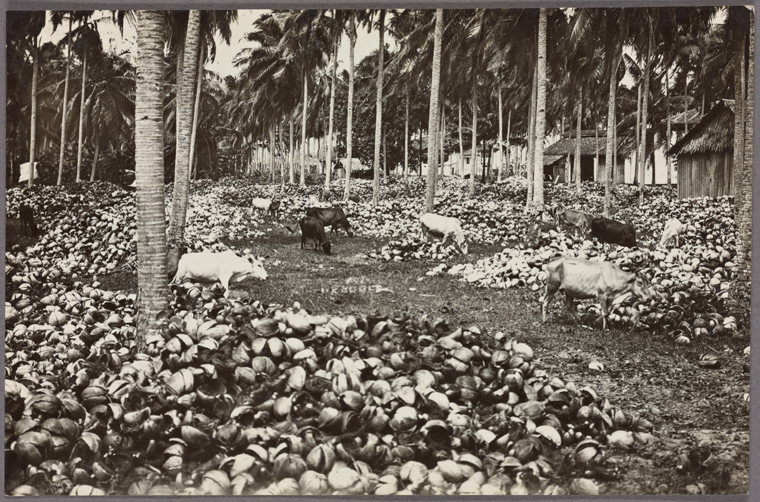
Kampongs had open spaces for growing food and raising livestock.
Art and Picture Collection, The New York Public Library. “Cattle grazing amid piles of coconut shells, Singapore. The New York Public Library Digital Collections. http://digitalcollections.nypl.org/items/c2634d03-24a9-f238-e040-e00a18061845
Unlike life in modern Singapore, kampong life was simple and idyllic. The pace of life was slower and less stressful, and it was impossible to walk around without nodding at a familiar face.
Large extended families lived together under one roof and everyone, including children, helped with household duties like laundry and feeding the chickens.
Kampong food
With more space to maneuver about in the kampong, most kampong folks also raised chickens and pigs, and tended to vegetable beds and fruit trees.
Here’s a sample of what kampong folks ate:
Freshly caught fish and seafood, like sotong (squid), cockles and prawns
Homegrown vegetables and fruits grown without pesticides
Rice, tea and biscuits bought from shops
Treats like ice balls and cold drinks were bought from street vendors
Homemade kueh (Malay cakes) were shared with family and neighbours
Malay vs. Chinese kampongs
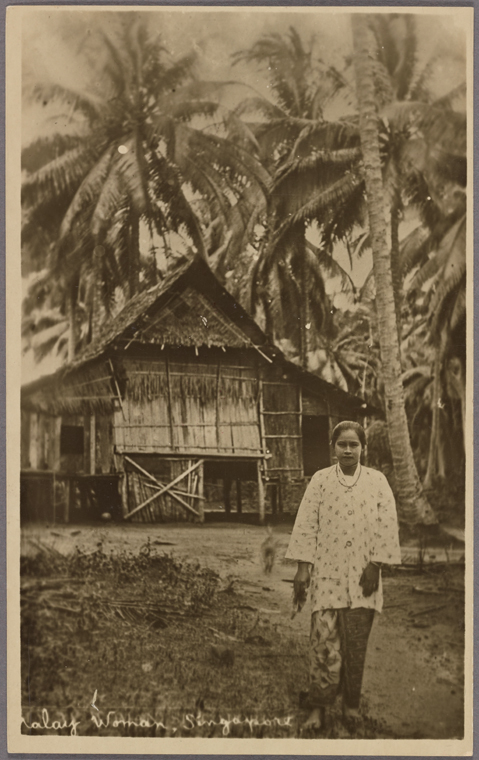
Malay woman in a Malay kampong. Note the stilts and gabled roof. Art and Picture Collection, The New York Public Library. “Malay woman, Singapore.” The New York Public Library Digital Collections. http://digitalcollections.nypl.org/items/c2634d03-249f-f238-e040-e00a18061845
Depending on the racial makeup of the kampong, the settlement could have different amenities and architecture.
Generally speaking, in a Chinese kampong, there were:
Chinese stores like medicine shops and provision shops selling herbs and sundries
Single-storey dwellings with zinc roofs
Houses with fences
Pigs raised by the home owners
In a Malay kampong, there were:
Mosques
Houses built on stilts to keep out wild animals like snakes and tigers, and to provide ventilation and prevent flooding
Houses with stairs to get to different floors
Houses that are were fenced off
Not always idyllic
Life in the kampong might have been slower-paced but it wasn’t without its difficulties. Flooding was a common occurrence for many rural kampongs.
Sources of water for kampong folks:
wells dug by homeowners
piped water to public standpipes (available in the 1950s after the government constructed a water supply system to provide running water to rural areas)
piped water to individual homes (this was available around 1960s)
Queuing for water
In case you were wondering what a standpipe was, it’s basically a faucet located in a public area like a town square that’s open to the public. It provided running water to residents living in the area.
Public standpipes were the first form of running water available in the kampong and villagers had to queue up to fill their buckets. It was a laborious process to haul water home, so many villagers simply bathed, and washed their clothes and dishes by the standpipes.
Hot sticky kampong nights
To get a good night’s sleep in the kampong, mosquito netting is a must. https://commons.wikimedia.org/wiki/File:Mosquito,net,TamilNadu403.JPG
If you cannot imagine living without air conditioning in tropical Singapore, just imagine how uncomfortable it must have been for the villagers on a hot sticky night in the kampong.
Most people in the kampong slept under mosquito netting for protection from the pesky bugs, and with no electricity to power fans, they simply laid as still as possible to stay cool. According to my mother who grew up in a kampong, restless nights were common, but somehow, they still managed to fall asleep.
If you are lucky enough to talk to a former kampong dweller, chances are you’ll hear about something called the “kampong spirit”.
Broadly speaking, the kampong spirit is about cooperation and sharing with people in your kampong. It is similar to the Hawaiian aloha spirit.
Kampong folks were known for their kindness towards one another, as well as towards outsiders.
One famous example of kampong spirit took place during WWII, when Singapore was occupied by the Japanese forces. British and Australian residents, as well as other foreigners living in Singapore were rounded up by the Japanese forces and were taken to POW camps.
During the long hot march to the POW camp, the marchers passed through a few rural kampongs and eye-witnesses recalled that several brave kampong folks rushed out of their homes to hand the POWs water and coconut water.
Such selfless acts may be surprising to us but to a kampong dweller, it was just part and parcel of kampong life. It was simply the way things were done in the kampong.
Jackfruit tree
Bartering was a way of life. A couple of eggs for one’s neighbour yielded a gift of juicy mangoes next week; fixing a broken bicycle for a neighbour meant an extra hand was ready to help when it’s time to repair the leaking roof.
On and on, these little acts of kindness reinforced what it meant to live in a kampong, and fostered a cosy sense of belonging in every kampong resident.
Even luxuries were shared freely – it was common for neighbours to listen to the radio or watch TV together, as radio and television sets (black and white only) were affordable only to a lucky few.
If you grew up in a kampong, then you may recall sitting in a neighbour’s living room or coffee shop listening to a radio program broadcast by Reddifusion (Singapore’s first commercial radio station).
The Kampong Kitchen – birthplace of Singapore cuisine
So there you have it, a tour of the rustic kampongs of Singapore where the now world-famous Singapore cuisine was born!
Top image credit: A Malay kampong in Singapore. Art and Picture Collection, The New York Public Library. “Malay – village Pulo Brani Singapore.” The New York Public Library Digital Collections. http://digitalcollections.nypl.org/items/c2634d03-24af-f238-e040-e00a18061845
Mixed martial arts — banned in New York and decried as “human cockfights” by Sen. John McCain — is going mainstream.
MMA officials just launched a campaign to eliminate an 11-year ban on competitions in New York.
On Friday, the sport will explode onto the big screen with the release of “Never Back Down,” starring Sean Faris and Djimon Hounsou.
At the Renzo Gracie Jiu-Jitsu Academy in midtown, enrollment in its Brazilian jiu-jitsu classes has jumped threefold in two years. MMA includes many of the techniques found in Brazilian jiu-jitsu. The academy has produced some major MMA fighters — including members of the famed Gracie clan.
MMA resembles a bar brawl, complete with kicks, punches and blows to the head. The matches end with a takedown where the loser is choked into a stranglehold or forced into submission by a limb lock.
That said, MMA fighters shrug off the danger.
“MMA looks violent but the fighters are pros,” said MMA fighter Igor Gracie.
“Anyway, there are good doctors,” he added.
He should know. Gracie has suffered a broken nose, and his head’s been stitched up a few times. Still, he said the sport is not all about brute force, and that it is 30 percent physical, 30 percent technique and 40 percent mental.
The Gracie name is synonymous with MMA, but the sport’s roots go back to an ancient Greek sport pankration, which combined boxing moves with wrestling techniques. There were few rules in a fight: no biting or eye gouging. Fights often ended with the loser’s death.
Its modern equivalent never goes that far. The Ultimate Fighting Competition, the largest and most prestigious MMA competition, outlaws groin attacks, fish hooking, head butting, eye gouging and spitting.
Even with restrictions, a typical fight makes wrestling matches look like some fantasy role-playing sequence.
How many votes does it take to win the U.S. presidency? Read an electoral vote map to find out.
Whether it’s choosing the next American Idol or deciding what’s for dinner, making decisions in a group often involves voting for your favorite. Whichever option receives the majority, or more than half, of all the votes is the winner. But when it comes to the U.S. presidential election, the majority vote doesn’t always decide who wins.
Just look at what happened in 2000. It was the closest election in U.S. history. Then Vice President Al Gore received 50,999,897 popular votes (individual votes), while 50,446,002 voted for the then Texas Governor George W. Bush. Yet Bush was the winner. How did it happen?
Simple. The president is elected by a majority of electoral votes, not popular votes. Each of the 50 states and Washington, D.C., is assigned a certain number of electoral votes. The greater the state’s population, the more electoral votes it gets. In most states, the candidate who receives the majority of the state’s popular vote wins all of that state’s electoral votes. * (Chosen electors from each state actually cast these votes in mid-December, nearly a month and a half after the November 4 election. These electors are known as members of the Electoral College.)
In 2000, Bush won 30 states for a total of 271 electoral votes. Gore won only 20 states, receiving 266 electoral votes. ** What does it all mean for Senator Barack Obama and Senator John McCain? They have run their campaigns in an effort to get a majority of the 538 total electoral votes. So in a way, majority does still rule!
*Nebraska and Maine divide their electoral votes by districts within the state.
The middle-age man with a weather-beaten face crouches over a red book in a corner off the sidewalk and scribbles on a notepad, while a young woman sitting across him wears a worried expression.
After an agonizing few minutes for the fidgeting woman, the man looks up from under his worn straw hat and speaks to her in soft, reassuring tones. She nods and reaches into her purse to pull out a $20 bill. The man accepts the money and bids her farewell.
Master Li has just seen his first patient of the day.
Li Feng Jun — or Master Li, as he is more commonly known on the crowded streets of Flushing — is not a doctor. He is a Chinese fortune-teller.
He sits outside the LIRR Main St. station in a recess off the busy sidewalk seven days a week, rain or shine, to advise the worried and the dejected.
The beginning of the new year marks the peak season for fortune-tellers. This is the time when anxious souls approach Master Li to find out if Lady Luck will beckon in the year ahead.
Fortune-tellers such as Li play a unique role in Chinese society. They are often respected professionals who advise businesses about deals and mergers.
To troubled individuals, they also act as discreet street psychotherapists. Their methods are unorthodox — usually invoking superstitions about a patient’s karma and consulting arcane manuals to divine the future.
But for those who fear the stigma of mental illness, their services can be invaluable.
Li, 56, claims no special powers but rather relies on years of experience in reading faces — and a little red book containing astrological data — to ascertain a person’s fate.
“My job is to reduce their stress,” said Li, who believes that much that stress comes from adapting to a new country.
“They are worried about money and finding a job. They talk of suicide and turning to crime to make ends meet,” Li said of his customers.
After 28 years in the business, Li has heard it all. “Love, money, family and work. What else?” he said. “People have the same problems everywhere. In China and in America.”
The big difference in America, Li said, is that the cops let him be. “In China, the government would harass me constantly and I have to keep moving about in the marketplace. Here, no one bothers me,” he said.
So he camps outside the LIRR station on a rickety stool his eyes scanning the passing faces. In the summer, he steels himself against the heat with a bottle of water and a battered straw hat with a band that reads “Good Luck.” In winter, a velvet fedora, a heavy wool coat and thermos of tea protect him from the elements.
But Li isn’t without his critics.
“Such superstitions can harm people,” said Susan Wu Rathbone, known in the neighborhood as Auntie Wu. She is the founder of the nonprofit Chinese Immigrant Services.
Like Li, Auntie Wu helps people with their problems. But she relies on more practical methods.
“We provide English classes and help immigrants find jobs and housing,” said the outgoing octogenarian. “Everything is free of charge.”
Katia Frishman tried for four years to get pregnant and finally underwent in vitro fertilization, only to miscarry after three weeks.
The 37-year-old Upper East Side woman and her husband didn’t give up, but decided to supplement their efforts with a method rarely mentioned in Western fertility clinics: Acupuncture.
Sticking needles into a woman to help her conceive may sound like quackery, but a recently published study backs what acupuncturists have long claimed: the ancient Chinese practice may help women undergoing in vitro fertilization become pregnant. The study, published in the British Medical Journal, found that acupuncture before and after embryo transfer increased the chances of pregnancy.
“The fertility drugs my doctor prescribed were really hard on my body,” said Frishman, vice president for IT technology procurement at a hedge fund. She decided to try acupuncture after researching the subject on the Internet. Five months later, she was pregnant. “I was really surprised when I got my blood test back,” she said.
Frishman’s dream came true on Feb. 20 when she gave birth to Maya Isabella, who weighed in at a healthy eight pounds, one ounce.
“My husband and I are just over the moon now,” said the overjoyed mom.
Acupuncture is the practice of inserting fine sterile needles into specific parts of the body known as acupoints. According to Xiu Juan Yang, an E. 55th Street acupuncturist who specializes in treating infertility, the needles stimulate both blood flow and what Chinese medicine identifies as “Qi” a kind of life force flowing through the body.
“Acupuncture works because it increases blood flow to the uterus and ovaries,” she contends.
Because the needles are very fine and don’t pierce the flesh deeply, the treatment is painless. “I used to go in and take a nice nap for 45 minutes,” said Frishman. “It was very relaxing.”
The treatment usually spans about 45 minutes to an hour, and after an initial session priced at $110, patients pay between $50 to $100 per visit. Most patients undergo 15 to 20 sessions.
Laura H., a 44-year-old who works in law enforcement was “very skeptical” when she heard about using acupuncture to treat infertility. “I wouldn’t say I was desperate to have a baby but I was very close to it,” she said.
With the help of intrauterine insemination and regular acupuncture sessions, Laura is now into her second trimester of her pregnancy: “For me, I see a clear correlation between acupuncture and pregnancy,” she said.
Despite the recent study, carried out by researchers from the University of Maryland School of Medicine, Georgetown University School of Medicine and VU University in Amsterdam, Western medical research is divided on whether acupuncture can help treat infertility.
Dr. Zev Rosenwaks, director of The Center for Reproductive Medicine and Infertility at New York-Presbyterian Hospital/Weill Cornell Medical Center warns that it is too early to draw any conclusions. “I am not sure if this completely proves that acupuncture works,” he said.
Still, there’s no harm in trying, Rosenwaks added: “We have to keep an open mind.”
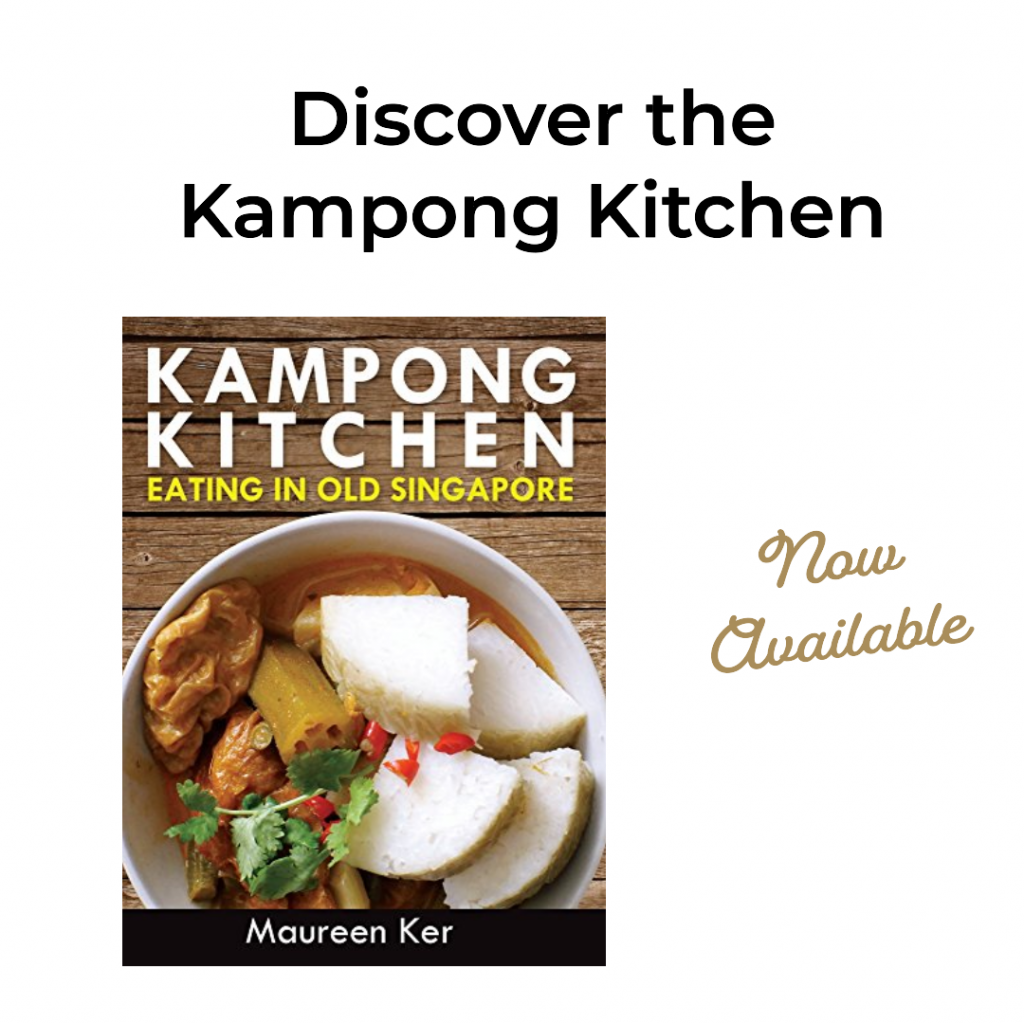
Maureen Ker’s book, Kampong Kitchen, is an evocative culinary journey that brings the sights and smells of old Singapore to life.
In this nostalgic trip to old Singapore, you’ll relive the days of rickshaws and water-hauling bullock carts, and nights filled with satay smoke and the clamor of street hawkers.
Step into the Kampong Kitchen and learn how inventive cooks from 5 distinct ethnic groups created signature dishes like laksa, otak-otak, bak kut teh.
From preserving food in the tropical heat to keeping bothersome chichak (geckos) out of the pantry, Kampong Kitchen — Eating in Old Singapore chronicles the hardship faced by its early settlers and the inventive cuisine they founded that helped transform Singapore into a world-renowned food paradise.
Packed with over 40 delectable recipes, including dishes like popiah, mee siam, fish head curry and pineapple tarts, this historical cookbook will delight cooks and history buffs alike.